


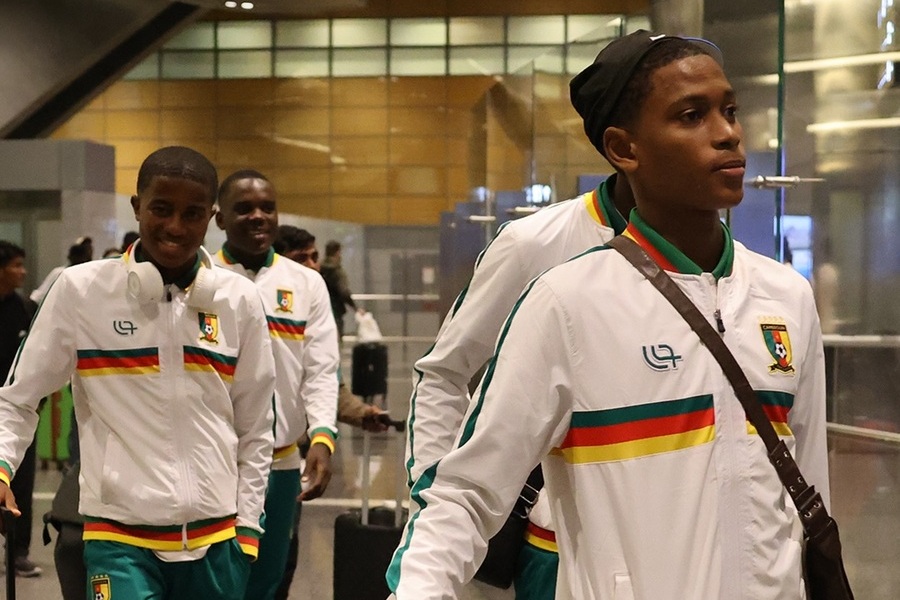
Qatar will host the FIFA U-17 World Cup for the second consecutive year, with the tournament scheduled to take place from 19 November to 13 December 2026.
The draw, held in Zurich on 21 May, confirmed the expanded format, with 48 national teams divided into 12 groups of four. All six continental confederations will be represented, including 11 European nations, nine Asian teams (including hosts Qatar), seven South American sides, eight representatives from North and Central America, three from Oceania and 10 from Africa.
The tournament will be particularly significant for African football, with Algeria, Cameroon, Côte d’Ivoire, Egypt, Mali, Morocco, Mozambique, Senegal, Tanzania and Uganda all securing places at the finals.
Here is a complete guide to the 12 groups, all 48 participating nations and the challenges facing Africa’s representatives in Qatar.
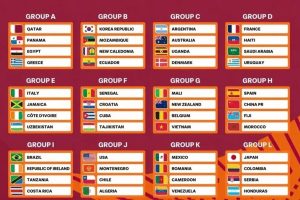
FIFA U-17 World Cup 2026: Full group draw
The 48 qualified teams have been drawn into 12 groups, with each nation set to face three opponents during the opening stage.
| Group | Teams |
|---|---|
| A | Qatar, Panama, Egypt, Greece |
| B | South Korea, Uganda, New Caledonia, Ecuador |
| C | Argentina, Australia, Mozambique, Denmark |
| D | France, Haiti, Saudi Arabia, Uruguay |
| E | Italy, Jamaica, Côte d’Ivoire, Uzbekistan |
| F | Senegal, Croatia, Cuba, Tajikistan |
| G | Mali, New Zealand, Belgium, Vietnam |
| H | Spain, China, Fiji, Morocco |
| I | Brazil, Republic of Ireland, Tanzania, Costa Rica |
| J | United States, Montenegro, Chile, Algeria |
| K | Mexico, Romania, Cameroon, Venezuela |
| L | Japan, Colombia, Serbia, Honduras |
All 48 teams qualified for the FIFA U-17 World Cup
The 48 places have been allocated across FIFA’s six continental confederations, with Qatar qualifying automatically as the host nation.
Five countries – Greece, Montenegro, Romania, Serbia and Vietnam – are set to make their first appearances at the U-17 World Cup.
| Confederation | Places | Qualified teams |
|---|---|---|
| AFC (Asia) | 9 | Qatar (hosts), Australia, China, Japan, South Korea, Saudi Arabia, Tajikistan, Uzbekistan, Vietnam |
| CAF (Africa) | 10 | Algeria, Cameroon, Côte d’Ivoire, Egypt, Mali, Morocco, Mozambique, Senegal, Tanzania, Uganda |
| CONCACAF (North and Central America) | 8 | Costa Rica, Cuba, Haiti, Honduras, Jamaica, Mexico, Panama, United States |
| CONMEBOL (South America) | 7 | Argentina, Brazil, Chile, Colombia, Ecuador, Uruguay, Venezuela |
| OFC (Oceania) | 3 | Fiji, New Caledonia, New Zealand |
| UEFA (Europe) | 11 | Belgium, Croatia, Denmark, France, Greece, Italy, Montenegro, Republic of Ireland, Romania, Serbia, Spain |
African teams and their group-stage opponents
Africa’s 10 representatives have been drawn into 10 different groups, meaning that only Groups D and L will feature no African nations.
| African team | Group | Group-stage opponents |
|---|---|---|
| Egypt | A | Qatar, Panama, Greece |
| Uganda | B | South Korea, New Caledonia, Ecuador |
| Mozambique | C | Argentina, Australia, Denmark |
| Côte d’Ivoire | E | Italy, Jamaica, Uzbekistan |
| Senegal | F | Croatia, Cuba, Tajikistan |
| Mali | G | New Zealand, Belgium, Vietnam |
| Morocco | H | Spain, China, Fiji |
| Tanzania | I | Brazil, Republic of Ireland, Costa Rica |
| Algeria | J | United States, Montenegro, Chile |
| Cameroon | K | Mexico, Romania, Venezuela |
Tough challenges and intriguing match-ups for Africa’s representatives
Mozambique and Uganda secured their places at the tournament through the play-offs, with both sides progressing after penalty shoot-outs. They now face demanding tests against established international youth football nations.
Mozambique have been drawn in Group C alongside Argentina, Australia and Denmark. The South Americans and Europeans will provide stern opposition, leaving little room for error for the African side. Their ability to compete physically and remain organised defensively could prove crucial.
Uganda, meanwhile, will face South Korea, New Caledonia and Ecuador in Group B. The Cranes will be hoping to take advantage of their opportunities against the three opponents, with their matches against New Caledonia and Ecuador potentially playing an important role in their qualification hopes.
Morocco, who missed out on the continental title after losing on penalties, face one of the toughest assignments among the African nations. They have been placed in Group H alongside Spain, China and Fiji, with the meeting against the Spanish side expected to be a major test.
Tanzania, runners-up at the Africa Cup of Nations, have also been handed a challenging draw. The East Africans will take on Brazil in Group I, while Republic of Ireland and Costa Rica complete the group. Their encounters against the latter two nations could be particularly important in their bid to reach the knockout stages.
Other African sides may have reason to be more optimistic.
Africa Cup of Nations champions Senegal will compete in Group F alongside Croatia, Cuba and Tajikistan. Mali have been drawn against Belgium, New Zealand and Vietnam in Group G, while Egypt will meet hosts Qatar, Panama and Greece in Group A.
Côte d’Ivoire face Italy, Jamaica and Uzbekistan in Group E. Although Italy represent a significant challenge, the Ivorians will be looking to make their mark and compete for a place in the next round.
Algeria and Cameroon also face demanding group campaigns. Algeria have been placed in Group J alongside the United States, Montenegro and Chile, while Cameroon will compete in Group K against Mexico, Romania and Venezuela.
Both African teams will need consistent performances to secure qualification, particularly against their North and South American opponents.
How does the FIFA U-17 World Cup 2026 format work
The 48 participating nations will be divided into 12 groups of four teams, with each side playing three group-stage matches.
The top two teams from each group will automatically qualify for the Round of 32. They will be joined by the eight best third-placed teams, completing the 32-team knockout line-up.
From that stage onwards, the competition will follow a straight knockout format, with the winners progressing through the Round of 16, quarter-finals and semi-finals before the final.
The expanded tournament will feature 104 matches in total, with the final scheduled for 13 December 2026.
Which groups are the toughest at the U-17 World Cup
Group D appears particularly competitive on paper, despite being one of only two groups without an African representative. France, Uruguay, Saudi Arabia and Haiti will all be targeting a place in the knockout stages, making qualification far from straightforward.
Group C is another intriguing section, bringing together Argentina, Denmark, Australia and Mozambique. The presence of two established football nations from Europe and South America makes it a difficult assignment for the African newcomers.
Group I also promises plenty of competition, with Brazil, Republic of Ireland, Tanzania and Costa Rica drawn together.
From an African perspective, Groups E and H look particularly challenging. Côte d’Ivoire will have to negotiate a group featuring Italy and Uzbekistan, while Morocco face Spain, one of the leading nations in youth international football.
By comparison, Senegal’s Group F and Mali’s Group G appear to offer more opportunities for African sides to progress. Both teams will nevertheless need to be consistent against opponents from Europe, Asia, Oceania and the Caribbean.
Algeria’s Group J and Cameroon’s Group K also look relatively open, with both African nations facing opponents from different footballing regions.
With 10 African teams competing across 10 groups, the continent will have a strong presence at the tournament. The challenge now is to turn that representation into a successful campaign and secure as many places as possible in the knockout stages.

Comments 2